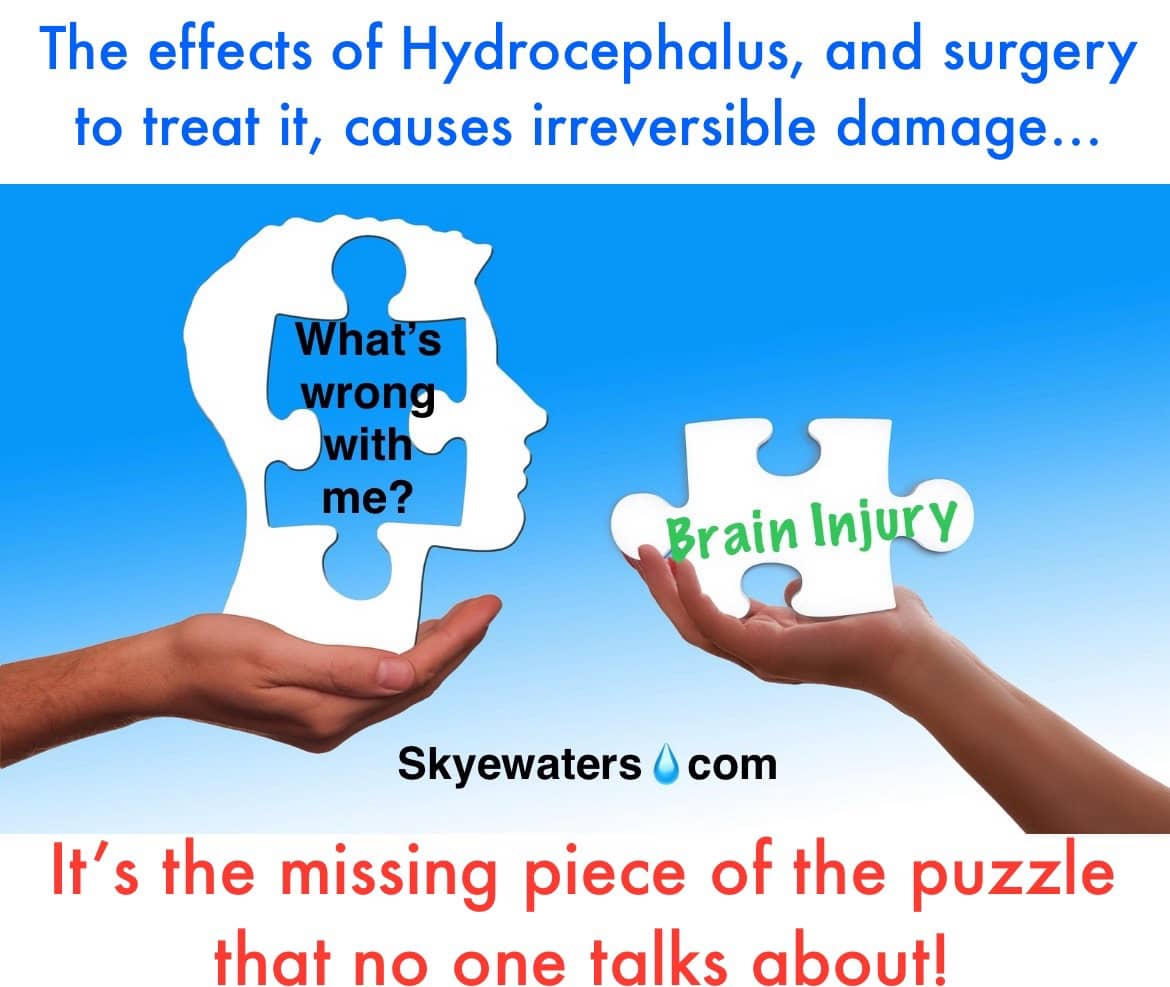
Brain injury: The missing piece you need to think about
If you’ve been diagnosed with Hydrocephalus and had brain surgery to treat it, does any of this resonate with you?
- Ever wonder(ed) why you’re struggling cognitively?
- Does your short-term memory feel like crap!?
- Maybe you feel like your brain is literally in a sink hole and you simply can’t get out.
- Or you may be feeling trapped inside yourself.
If so, have you ever considered and looked into the effects of brain injury? More specifically, the cognitive effects.
If you already have, this post might not be for you. Regardless, please feel free to read on. Better yet, share your thoughts or experiences in the comments.
If, however, you’re reading this and have recently received your diagnosis of Hydrocephalus, you might want to take note. Similarly, you may be a “veteran” or “warrior”, with a crazy number of brain surgeries already behind you.
If nothing else, this post is meant to give you some food for thought and/or spark possible discussion points with your neurosurgeon, in the future.
Disclaimer: This post is not a substitute for medical advice. Always consult your trusted physician.
It’s a damned if you do, damned if you don’t situation because we have NO choice.
When it comes to hydrocephalus, and the brain surgery we endure to treat it, not many neurosurgeons will factor in the resultant injury into the consultation discussion. (A failing on their part, in my opinion). Some may argue this is irrelevant, or inconsequential, since we have NO real choice. I beg to differ.
While this may seem like a no-brainer (pun intended), it’s not as obvious until you start struggling to function, especially cognitively. Adding to the complexity of your situation are the people who cause you to feel like you need to prove your injury.
Unfortunately, when you function better than most with a brain injury, it casts a shadow of doubt. It’s something that leaves the hoops you must jump through, all the more challenging. A clear case of what came first, the chicken or the egg?
Be aware: Medical gaslighting is not uncommon in this instance, taken to the next level by some. It will leave you feeling like you’ve lost the plot…having to prove yourself to everyone except the dog!
I’ll be the first to tell you; You are NOT crazy❣️
You are experiencing the effects of the condition and the treatment options.
Shunt surgery
The way I see it, drilling a hole in the skull and feeding/pushing a foreign object (shunt) through brain matter, causes *injury.
More importantly, depending on the area of the brain your neurosurgeon goes through, the probability exists that there are bound to be some neurological deficits. It may be apparent immediately OR it may present later. Some may be short-term and others not…
*See resource link below for an interactive brain map to discover what each lobe of the brain controls, correlate this with the effects you’re experiencing and then decide for yourself. Alternatively, feel free to do your own Google search.
Endoscopic Third Ventriculostomy (ETV)
If not a shunt, and assuming you’re a candidate (not everyone is), your neurosurgeon may discuss doing an ETV. This procedure carries its own risks, as do all surgeries. Admittedly, a brain bleed is something I couldn’t fully appreciate, until after it happened to me during a repeat ETV.
The bleed was caused when he attempted to widen the stoma (hole in the ventricle). While he managed to contain the bleeding (mostly), and succeeded at widening it, effectively addressing the intermittent treatment failure symptoms pre-op, the damage had unfortunately been done…
Every brain injury is unique
My story may not be your story, but it very well could be…
I must be clear; just because I suffered a bleed does not mean it puts me into a different box. Looking back, trying to connect the dots post repeat ETV surgery (May 2021) thinking back on my struggle at work and life because of it, I can see the toll my brain has taken over the years!
The signs were there; I was simply uninformed and unaware…
Isn’t hindsight and the internet a wonderful thing…?
My (hindsight) tell-tale signs and the missed opportunities by so many medical professionals to adequately inform me:
- Going undiagnosed after 2 episodes of viral meningitis (7 years apart). A cause of brain injury unbeknownst to me at the time.
- Only being diagnosed with hydrocephalus 5-6 years later.
- Then, of course, the cognitive challenges I experienced after each subsequent surgery (7 at time of this post). Each one adding to the load and severity.
Despite having struggled and figuring out strategies to overcome my challenges, since my initial diagnosis and VP shunt placement in May 2007, I managed each time without knowing that I was living with a brain injury. Developing strategies along the way, some of which leave me shaking my head now. Both in disbelief and awe at my resilient self.
In fact, it’s obvious to me (now) that my development of strategies started in my final year of school, before my final exam, after contracting viral meningitis for the first time!
I was only made aware of all this in October 2023 when I sought help from the PA Hospital Brain Injury Rehabilitation Unit (BIRU), Brisbane, Australia. While their services may prove useful to some, my experience has been less than ideal. I’d even go as far as saying; traumatic due to being triggered each time I speak about it.
Trust, once broken by medical professionals, is harder to come back from. But, when you’re reliant on them for your survival, literally, it’s a bitter pill to swallow. Ultimately, it leaves the patient in a vulnerable state causing them to avoid seeking medical attention, especially when they need it most.
Truthfully, the worst thing I could have done was to ask my GP for a referral, in the hope of getting help. But that’s a blog post for another day! Maybe.
*I have since self-discharged and have successfully been exploring alternative treatments, which have yielded positive results albeit slowly. I will share more on this later.
If only I knew then what I know now…life could have been so much different!
There are so many causes of brain injury, one cannot possibly discount anything. In the case of Hydrocephalus, for example, it could be due to:
- An increase in intracranial pressure, when hydrocephalus goes untreated, or treatment is delayed, effectively causing more harm than good.
- When CSF (cerebrospinal fluid) builds up, it pushes against structures in the brain, putting unnecessary pressure on it. Not quite the image we like to think about but one that drives this point home; the size of an infant’s head increasing as it grows, due to the skull not having fused yet.
- And, as pointed out in this post, the surgical treatment(s) we endure. Each time.
In adults, the fluid has nowhere to go and causes excruciating pain from the pressure buildup.
I will not presume to speak for everyone, but will do so from my own experiences, as I always do. My hope, others will benefit in a positive way, if only to educate and spread awareness.
The impact is life changing and has a snowball effect
I now live with Executive Dysfunction, even more so, something that has turned life as I know it, completely upside down. I do believe it should not have been as difficult as it was to get to understanding what was happening to me. Left in a state of confusion, as my memory and cognitive skills failed me, more and more…
I felt the person I once knew slipping away and watched as she tried to claw her way out of the prison cell she had been banished to. Solitary confinement if you like. A situation akin to being buried alive, screaming for help but no one hears you, a thought which leaves me feeling claustrophobic. Helpless even. Despite my best efforts to improve my situation, it was seemingly all in vain. Until I had no other choice but to concede defeat.
Honestly, I feel let down by the systemic failures I have encountered along the way. I continue to experience them, as I try to navigate life with this invisible injury, on my own. This quote seems fitting:
“You never know how strong you are until being strong is the only choice you have” – Bob Marley
Admittedly, I am still a long way off from where I would like to be however, I continue to find new ways to move from day-to-day, moment by moment. I acknowledge the improvements I’ve made and credit the use of alternative therapies. Also, strategies are a godsend as they provide me with ways to successfully navigate life right now.
Whilst the effects of that surgery have had a profound impact on my life and essentially left me without a job, struggling to hold it together most days, and at times wishing that I had instead succumbed on that operating table, instead of being sent home to deal with “this”; I remain thankful for my intellect still being intact, my self-awareness, and the determination to see myself through the challenges and obstacles. Regardless of how long it takes me…
What you can look out for from me (brain permitting)
I will continue to be transparent and unashamedly vulnerable by:
- Sharing the strategies I use, to overcome or work through my cognitive challenges. Things I do to help myself navigate this thing called life post diagnosis, and brain injury.
- Speaking out about the systemic failures and their impact. My obligations lie with no one else other than myself. My hope: Change for the better. Pure and simple.
- Spreading awareness, especially on LinkedIn. Being part of the solution is better than adding to the problem. I firmly believe in the value of lived experience and insight to help inform employers to achieve a positive outcome for all, especially those who are sincere in their diversity and inclusion statements.
Life offers us all the opportunity to do better, when you know better. It’s what you do after that matters and speaks to your integrity.
*Reference: The interactive brain map may be of some help in understanding certain deficits you may or may not be experiencing.